![[logo] US EPA](./EPA Response to September 11 _ Region 2 _ US EPA_files/logo_epaseal.gif)
Pictures from the World Trade Center Response
Monitoring the Air and Water
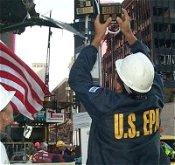 For
months after September 11, EPA took samples of the air, dust, water, river
sediments and drinking water and analyzed them for the presence of pollutants
that might pose a health risk to response workers at the World Trade Center
and Pentagon sites and the public. These monitoring data are available
both in table form and in summaries.
For
months after September 11, EPA took samples of the air, dust, water, river
sediments and drinking water and analyzed them for the presence of pollutants
that might pose a health risk to response workers at the World Trade Center
and Pentagon sites and the public. These monitoring data are available
both in table form and in summaries.
Dust Suppression and Removal
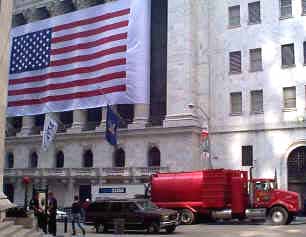 Within
days of the disaster, EPA had ten vacuum cleaner trucks blitzing the financial
district. Power washers cleaned building fronts and wet down streets and
sidewalks to capture the dust prior to vacuuming.
Within
days of the disaster, EPA had ten vacuum cleaner trucks blitzing the financial
district. Power washers cleaned building fronts and wet down streets and
sidewalks to capture the dust prior to vacuuming.
Once Wall Street reopened, three of the giant vacuums, each capable of
capturing 15 tons of solid material, began systematically cleaning streets
and sidewalks, parking areas, parks and playgrounds in the impacted area.
Sandboxes were the most time consuming . all the sand had to be
removed and replaced.
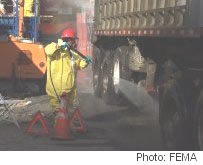 To
insure that dust was not tracked into the clean areas by people and vehicles
leaving the work zone, EPA established a number of wash stations . Workers
coming off the site had their boots washed. Cars and trucks were power-washed
and debris being hauled to piers was wetted down and covered so dust did
not fly about.
To
insure that dust was not tracked into the clean areas by people and vehicles
leaving the work zone, EPA established a number of wash stations . Workers
coming off the site had their boots washed. Cars and trucks were power-washed
and debris being hauled to piers was wetted down and covered so dust did
not fly about.
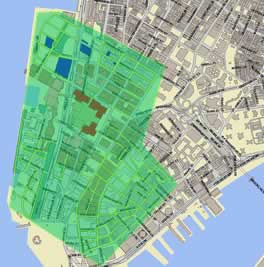 This
map shows the areas that were cleaned as of October 15, 2001. The recovery
effort concluded in June 2002.
This
map shows the areas that were cleaned as of October 15, 2001. The recovery
effort concluded in June 2002.
More Pictures
Follow links to larger versions of each photo. An article about EPA's experiences in the aftermath of the attacks provides context to these photos.
|
|
|
|
|
|
|
|
|
|
|
|
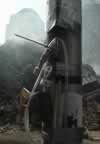 Air monitor near debris pile Larger picture |
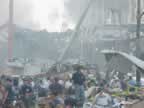 Volunteers and professionals alike rushed to help with recovery. Despite advice to wear respirators, many did not Larger picture |
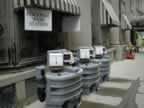 Personal wash stations for recovery workers. Larger picture |
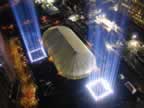 EPA central wash station framed by towers of light Larger picture |
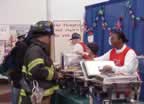 Recovery workers in EPA's central wash station Larger picture |
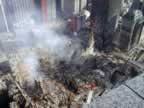 The enormity of the debris pile (courtesy NOAA) Larger picture |
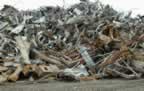 Recovered metal debris at Fresh Kills landfill Larger picture |
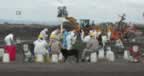 Sifting debris at Fresh Kills landfill Larger picture |
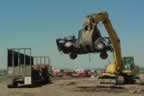 Hundreds of damaged cars were recycled at Fresh Kills Larger picture |
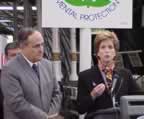 Administrator Whitman and Mayor Giuliani opening EPA's central wash station Larger picture |
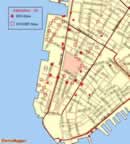 Map of asbestos air monitors Larger picture |
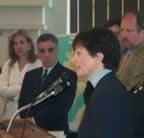 Regional Administrator Jane M. Kenny announcing EPA's dust cleanup plan Larger picture |
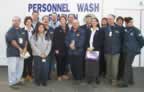 Some of the hundreds of EPA employees working on WTC-related issues Larger picture |